How to Get a Job in Germany:
Increase Your Chances
Getting a job is not just about having the right qualifications. Your success depends on how effectively you navigate the entire application process – from your application to the final job offer.
3 stages. 2 types of levers. 1 goal:
Increase your chances of getting hired.
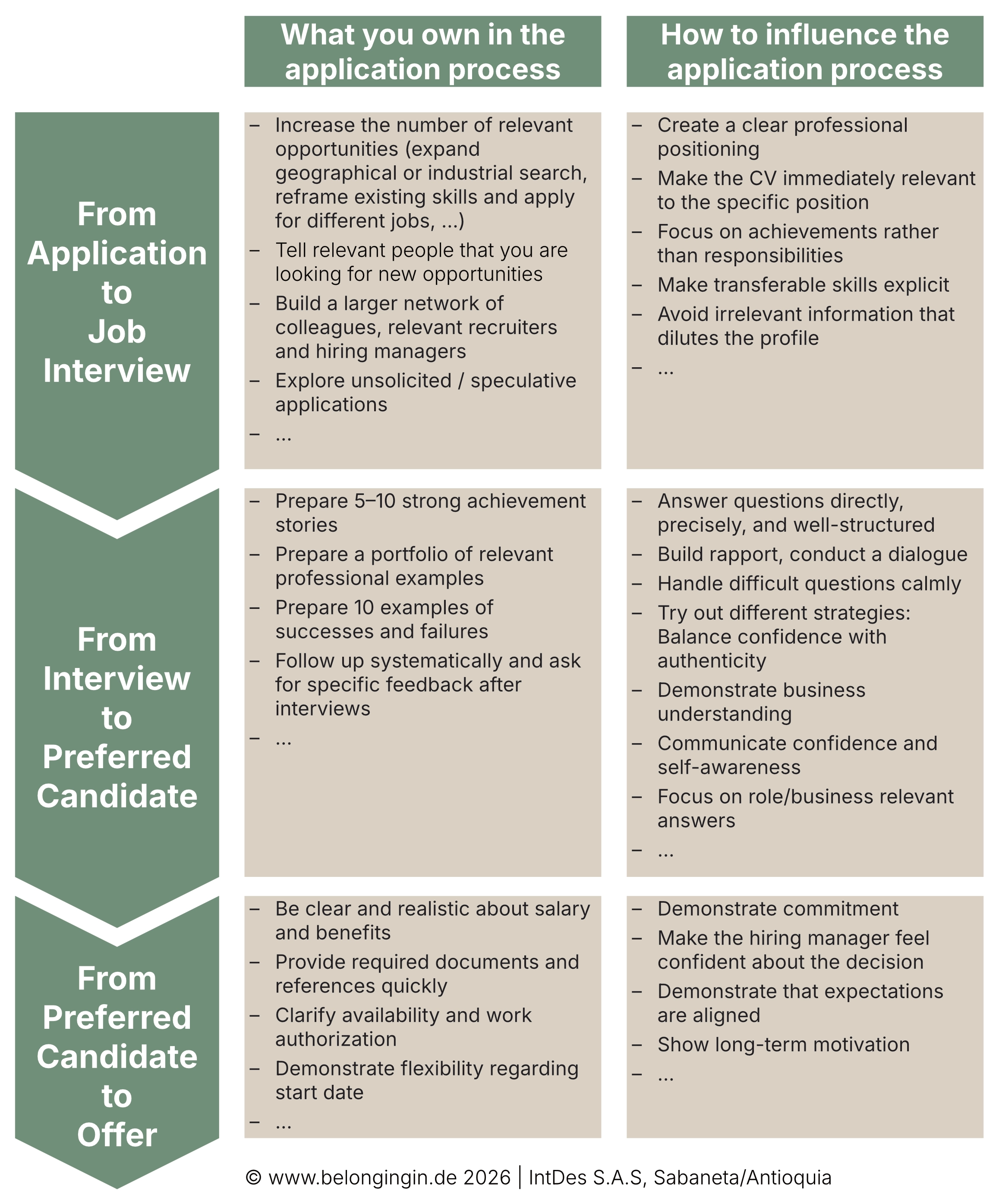
Your application runs ideally through three consecutive stages: from Application to Job Interview, from Interview to Preferred Candidate, and from Preferred Candidate to Offer. At each stage, you will face a different challenge and therefore need a different approach. Success therefore depends not only on doing the right things, but on understanding what can actually be controlled at each stage.
A useful distinction is between “What you own in the application process” and “How to influence the application process.” "What you own" refers to actions, decisions, preparation, and assets that are directly within your control. "How to influence the process" focuses on how you use these assets to shape the perception and decisions of others. You cannot control whether a company invites you, how an interviewer evaluates you, or whether an offer is made. But you can deliberately influence the probability of each outcome through relevance, clarity, credibility, confidence, and professional communication.
From Application to Job Interview
Your first challenge is earning the interview. Your goal is to increase the number of relevant opportunities and make your profile immediately compelling for each specific opportunity. What you own includes your professional positioning, CV, application materials, transferable skills, network, and knowledge of your achievements. How you influence the process means translating these assets into a clear value proposition for the specific employer and role.
Your application should quickly answer three questions: Who are you professionally? Why are you relevant? And what evidence demonstrates your value? Relevance beats completeness.
From Interview to Preferred Candidate
Once you reach the interview, the focus shifts from being relevant on paper to being convincing in person. What you own is your preparation: strong achievement stories, examples of professional experience, knowledge of the company and role, and a repertoire of responses to challenging questions.
How you influence the process is through the quality of the interaction. You need to answer directly and precisely, structure your responses, demonstrate business understanding, build rapport, and communicate confidence without losing authenticity.
The objective is not simply to give “correct” answers, but to create sufficient confidence that you can perform successfully in the role and would be a strong choice compared with the other candidates.
From Preferred Candidate to Offer
At the final stage, the question is no longer primarily “Is this person capable?”, but “Can we confidently make this person an offer?” What you own includes clarity about salary and benefits, availability, work authorization, references, required documents, and your willingness to accommodate practical requirements.
How you influence the process means reducing the employer’s remaining uncertainty and decision risk. You want the hiring manager to feel confident that expectations are aligned, that you are genuinely committed, and that there are no hidden obstacles to hiring you. Demonstrating flexibility, reliability, long-term motivation, and professional responsiveness can turn a preferred-candidate status into a concrete offer.
Why qualified international professionals still struggle to get hired
Better German can certainly help international professionals perform more convincingly in job interviews. A stronger command of the language makes it easier to understand nuanced questions, express ideas precisely, and communicate professional experience without constantly searching for the right words. It reduces the cognitive effort required to formulate an answer and allows you to focus more on the content of the conversation. But language proficiency alone does not make a strong interview performance.
What often matters even more is how you communicate your experience. Strong answers are structured, relevant and authentic: they make your contribution and achievements easy to understand without sounding rehearsed or artificial. At the same time, successful candidates convey confidence and composure. They demonstrate that they can explain complex issues clearly, respond thoughtfully to unexpected questions, and present themselves as credible professionals. In other words, the goal is not to speak perfect German—it is to communicate with clarity, authenticity and confidence.
Which levers of our framework have you already tried? The key is not to work on everything at once, but to identify the few levers that will make the biggest difference for you and turn them into practical, repeatable behaviors.
Moving on With Systemic Solution Oriented Coaching
Systemic, solution-focused coaching helps international professionals improve their interview performance quickly—without trying to turn them into someone they are not. Instead of focusing primarily on language deficits, coaching identifies what already works and builds on existing professional strengths.
You learn to structure your answers clearly, communicate your value authentically, and project confidence and composure—even when you cannot express yourself perfectly in German.
Through focused practice and feedback, you develop practical strategies for handling difficult questions, pauses and moments of uncertainty. The result: greater self-confidence, clearer communication and a more convincing professional presence in interviews.
Curious how this could work for you? Book a free Chemistry Call and let’s explore it together.
 I offer a free chemistry call to connect, discuss your current situation and possible levers to improve your performance in the application process.